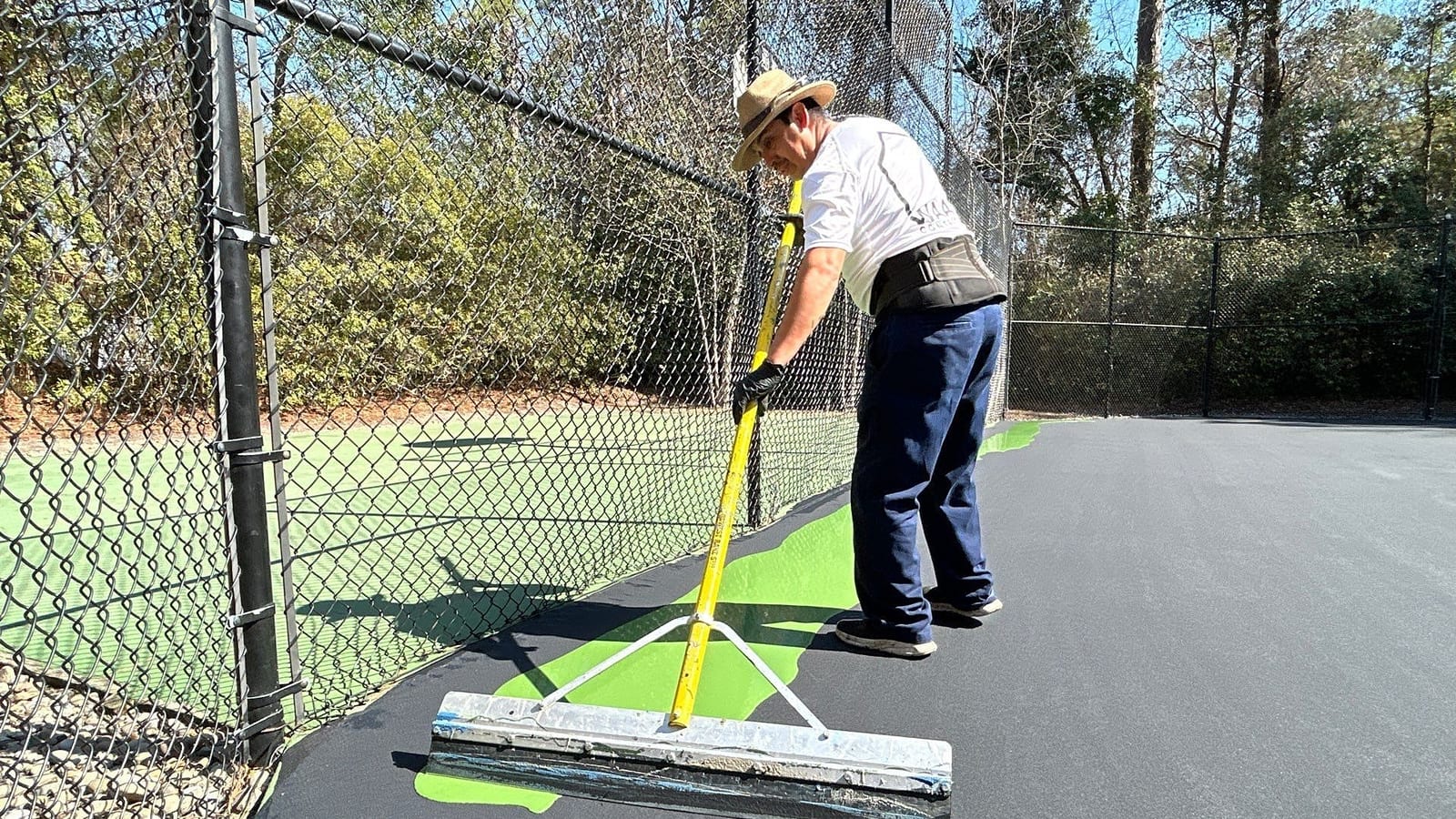
Court resurfacing & repair
Crack repair, resurfacer, color coats and new lines — the full SportMaster system applied by our crew.
Signs a Court Is Ready for Resurfacing
- · Faded color, worn texture, or a slick surface after rain
- · Peeling, delamination, or visible aggregate showing through
- · Hairline cracks that are spreading or connecting
- · Inconsistent ball bounce or standing water well after rain
- · Lines that have faded or peeled ahead of the rest of the surface
Only a few cracks or one low spot? See court repair — not every court needs a full resurfacing.
Scope Depends on the Court in Front of Us
Two courts the same age can need very different work. One may need a clean, a few hairline repairs, and color coats. Another may need extensive crack work, patching for low spots, and a resurfacer coat before any color goes down. We evaluate first, then write the scope. The items below are the building blocks; your proposal states which ones apply and how many coats are specified.
Cleaning & Surface Preparation
Pressure cleaning to remove dirt, mildew, and loose material so new coatings bond to a sound surface.
Crack Repair (as the condition calls for)
Method matches the crack: filler for hairline cracks, reinforced or membrane repair for working cracks. Repairs reduce and slow telegraphing; they do not stop slab movement, so we do not promise cracks will never return.
Patching & Leveling
Low spots that hold water are patched with acrylic patch material where the evaluation identifies them.
Acrylic Resurfacer (when specified)
A resurfacer coat fills texture and gives color coats a uniform base. Whether it is used, and how many coats, depends on the existing surface. Note: our one-coat Acrylic Resurfacer rule applies to new concrete courts and is not a blanket rule for resurfacing existing courts.
Color Coats
SportMaster color coats applied to manufacturer specification. The coat count is stated in your proposal based on the court's condition.
Line Striping
Lines taped and painted for tennis, pickleball, basketball, or blended layouts, to the layout confirmed in writing.
How a Resurfacing Project Runs
- Site evaluation. We look at the slab or asphalt, cracking pattern, drainage, existing coating, and the line layout, and note anything that points to a base problem rather than a surface problem.
- Written proposal. The proposal lists the repairs, whether a resurfacer coat is specified, the number of color coats, the line layout, the schedule, the price for that scope, and the warranty terms. Work outside that scope is priced separately in writing.
- Preparation and repairs. Cleaning, crack work, and patching as specified.
- Coatings. Resurfacer (if specified) and color coats, each cured per manufacturer guidance and weather.
- Striping and walkthrough. Lines are laid out and painted, then we walk the court with you and hand over care guidance and the written warranty.
Typical working time is one to two weeks per court once on site, weather dependent. Acrylic coatings need suitable surface temperatures and dry conditions to cure between coats.
Resurface or Rebuild?
Resurfacing assumes the slab or asphalt under the coating is structurally sound. If the evaluation finds settled corners, root heave, widespread structural cracking, or drainage that cannot be corrected at the surface, resurfacing will not hold up and we will say so. In those cases the honest recommendation is base repair or a rebuild, and we will explain why.
Planning estimate vs. warranty
Your proposal includes a maintenance-planning estimate: a budgeting guide for when to expect cleaning and the next recoat given the court's use, exposure, and upkeep. That is separate from the written workmanship warranty. Our default workmanship warranty is one year; certain construction options carry different terms, and the signed proposal controls. Neither document is a guarantee that cracks will not reappear.
Ranges from the instant estimate are preliminary planning figures. Final pricing depends on scope and a site evaluation; your signed proposal is the only firm price.
Frequently Asked Questions
How much does it cost to resurface a tennis or pickleball court?
It depends on the existing court's condition. Cracking, low spots, drainage, the number of coats the condition calls for, and line layout all change the price. Our published ranges are planning figures only; the written proposal after a site evaluation is the firm number.
When should I resurface my court?
When the surface tells you: faded color, worn texture, peeling, spreading cracks, inconsistent bounce, or standing water after rain. Timing varies widely with use, sun exposure, drainage, and how the court has been maintained, so we evaluate rather than quote a fixed interval.
What is included in court resurfacing?
The scope is set by the court's condition and stated in the approved proposal. Common steps are cleaning, crack repair, patching low spots, an acrylic resurfacer coat where the condition calls for it, color coats, and line striping. The number of coats and the repair method are specified in your proposal.
Will crack repairs keep cracks from coming back?
No contractor can promise that. Cracks in a court are usually driven by movement in the slab or base beneath the coating. Repair products and methods are chosen to reduce how much cracking telegraphs through the new surface and to slow its return, but they do not stop the underlying movement. We explain the expected outcome for your court before you sign.
How long does court resurfacing take?
Typically about one to two weeks of working time for a single court once on site, weather dependent. Acrylic needs suitable surface temperatures and dry conditions to cure between coats, so schedules can shift.
Will resurfacing change my court colors?
It can. Resurfacing is a natural time to refresh or change colors. SportMaster offers a range of standard colors, and we confirm the color combination in writing before mixing.
Start With an Evaluation
Site evaluation. Written scope and proposal. Warranty terms stated up front.
By Shane Waatti, Founder · Last updated